example.com/path/to/article
000 points · username · 0 hours ago
example.com602 points · 643 comments · 1 day ago · the-mitr
secabeen
fwlr
It’s weird that this has to be spelled out for so many engineers and economists, but to be very clear: OpenAI et al wants your token spend to go to one-minus-epsilon of what you previously spent on payroll, and wants your productivity to go to one-plus-epsilon of what it previously was. If you want 10x productivity, spend 9.9x more on tokens.
They are in the business of enclosure and rent extraction, and any innovation that comes out of their research and development - regardless of how real an innovation it is - will be completely contained and bent totally towards that business. Any leakage of the innovation that you experience as a productivity boost is literally felt as lost profits by them.
ttul
For sake of comparison, consider e-commerce. As a proxy for "impact on the economy", we can use Amazon's revenue. They went public in 1997 and that year had revenue of $148M (just 0.14% of Walmart's revenue that year). By 2000, revenue was $2.76B (1.65% of Walmart). Bricks and mortar didn't start feeling anything until probably 2011, when Amazon crossed 11% of Walmart's revenue. And it wasn't until 2025 that Amazon finally surpassed Walmart.
But, if you worked in tech in the e-commerce business, things were already feeling pretty hot by 2007. And at that point in time, the e-commerce sector was still miniscule compared to traditional retail (~4%). Software is very exciting these days and the most fantastic things are happening. They will eventually percolate out to the rest of the economy. But it will take many years before everyone notices the difference.
jstanley
poody
tapoxi
Other industries don't, so they have no way of knowing if the AI is bullshitting them outside of manual validation, which makes it more expensive and slower than doing it yourself.
TheAtomic
For a sec I thought he was talking about private equity.
Animats
so-gala-massey
osigurdson
The problem isn't that "AI doesn't understand..." this or that, as concluded by the article though. Its more a lack of creativity and incorrect reasoning about what AI can and cannot do. For one, whole role replacement is pure fiction and likely will never happen with LLMs. I expect most businesses will look very different in the next 10 years due to AI and it will not be smooth as the needed creativity will mostly happen in startups (and perhaps companies that can truly operate like startups) and diffuse out from there. I'd expect a lot of churn in the S&P493 and even the M7 most likely.
trzy
zmmmmm
cmiles8
2027 is going to be very interesting. Buckle up.
WillAdams
The thing is, the failure rate was quite high --- often only 15 (sometimes fewer) lines were returned, and after a while, Microsoft imposed a limit on uploading more files, even though I was deleting the conversations immediately and quitting CoPilot and re-starting (long sessions seemed to have a progressively worse failure rate).
Since then, access to CoPilot has been removed and we're waiting on a test program to finish. Kind of curious how many tokens this was using up (and if there's a model which could be run locally which would work well and quickly enough).
jgilias
jonatron
Fanmade
bentt
We have no idea where this will take us but it’s like measuring the effects of COVID in 2020. The immediate outcomes (temporary unemployment, massive stimulus) created long waves that we are still encountering (inflation, global instability).
specialp
At the start of this all, execs were clamoring for "AI" and at that time the models were superficially impressive but fell short. Now I think they are all underestimating the amount of improvement in the last year. There's loads of work that can be automated
neuronexmachina
You can see the computer age everywhere but in the productivity statistics. Robert Solow (1987)
jeffybefffy519
byko3y
I'm pretty sure most of the growth comes from companies laying off useless COVID-epoch engineers. If you lose the dead weight, you climb up without ever gaining more profit. And IT companies hired the most during COVID — the rollback is logical and it has nothing to deal with AI.
But this theory is harder to grasp than the sweet "growth is coming soon". Personally, I don't see any signs of long-term recovery after 2022, the US gov. debt growth is unsustainable, and the global market falls apart i.e. GDP growth while real markets collapsing will just collapse the currency.
spawrks
morelandjs
If you want to see if AI is paying off, look at new startups that build AI-native versus those that don't, controlling for the type of industry/product. This is a difficult causal inference comparison to make, but it's the one that I find most meaningful and interesting.
dzonga
for 'A.I' to work for the rest of industry outside of software - you need high touch customization.
drivebyhooting
No Signs of Tech Payoff Outside the Tech Sector. Manufacturing, basic science, education, etc languished while Big Tech reaped record profits and achieved stock heights for the last 15 years.
her0d0tus
trentnix
I'm seeing non-engineers use AI to send more emails, have more meetings, create more documents, and create more dashboards. So much of the busy work that happens in corporate environments was never that valuable in the first place. A firehose of busy work doesn't move any needles that matter.
serf
this is literally the textbook historical process across every industry ever.
tsoukase
taormina
adjejmxbdjdn
1. Even before AI, the U.S. economy was growing because of a handful of tech companies. The rest of the companies were collapsing.
2. If revenue per worker is stagnant despite AI investment, we don’t know what the revenue per worker would be without AI investment.
3. There’s no reason to believe AI should improve revenue. AI doesn’t just make companies more efficient. It makes their customers more capable of replacing their products. This continues all the way down to the individual. I might have thought about buying a calories tracking app in the past, but now, I can just use one of my AI Chat apps to do that for me.
AI might be reducing overall demand for services and therefore naturally contracting the exchange based economic system.
blobbers
Robots still seem far off. Its just like war, air superiority might make the war winnable but its the boots on the ground that are needed to actually take the territory.
638d127673
Maybe it takes a while to show up on the S&P 493's bottom line, but our token spend has had one of the best ROI as far as I'm concerned.
[deleted]
danans
AI may be a great calculator, but in business, intelligence is mostly judgment. Judgment depends on context, and the answer varies with which human or which model you ask. Perhaps most importantly, AI does not understand accountability, trust, culture, unwritten rules, ethical trade-offs or fairness, all of which shape reputational risk and ultimately drive revenue growth and profit margins.
All of this is true, but the reality is that LLM agents free up time for people to make judgement by taking care of the grunt work, which means each person can do more. That increased efficiency can mean higher revenues in growth industries and higher profits (through reduced labor force) in stable or declining industries.
stefangordon
sailfast
the AI story will be decided in the S&P 493, not the Mag 7
Maybe? But aren’t they the Mag 7 for a reason? Don’t they control a substantial part of GDP? Don’t they have a significant impact on the global economy that the s&p 493 may not - especially with large scale adoption of these tools.
Not saying that this means AI spending at current rates will be profitable or not crash - but only that there may only be 7-10 big companies at the end of all of this and the S&P 493 will be irrelevant (it’s one potential scenario in my book at any rate)
cuttothechase
The only issue is that the benefits would be more enmeshed with other gains in other industries.,
Heck, even in Software Development, the real benefits are not with mass labor elimination resulting in cost savings but with increasing available throughput. Technology if used to the fullest potential should be able to expand the proverbial pie., which is where the gains are!
That is not to say people won't try to save cost by eliminating labor due to AI., which is super shortsighted and misses the forest for the trees, but the overarching goal should be to increase the quality and quantity of deliverables, as demanded by the market.
abathologist
xbmcuser
dolebirchwood
cs702
Lots of theories seeking to explain this reality, but that's all they are: theories. Maybe some will be proven right. Maybe all will be proven wrong.
As of right now, the economic reality lags far behind the hype. But down the road... I wouldn't place a bet either way.
DebtDeflation
Right now, the most effective use case for AI is coding agents. Software development is a profit center for the tech sector, so it's not surprising that they're seeing big gains. In Corporate America, software development is part of IT which is a cost center, and the software landscape is 30+ years of bandaid-ed legacy systems, maintained by offshore contractors who submitted the lowest cost bid, so attempts to gain productivity via AI have not been as successful.
Where Corporate America has seen gains from AI in my experience is with customer support chatbots, but the customer service function overall in Corporate America is an unmitigated disaster, so the gains are hard to measure.
Beyond these two use cases, most people in Corporate America are just using ChatGPT to create slop and copy/pasting it wherever, and then goofing off in their newly freed spare time.
We need to see new AI use cases in Operations, Finance, Marketing, etc. that can handle business processes end to end before the productivity gains start showing up in the financials.
heohk
mbil
Yes there are technical solutions to such problems; I'm sure there's probably a startup to make phone calls that's hooked into your company's knowledgebase, multi-LLM workflows for document review, etc. But non-tech companies aren't adopting those. Tech companies came for the software generation and stayed for the general knowledge worker productivity. Since 2023 they made the investments to procure services, change culture, and generally re-tool. Software companies are also uniquely positioned to deal with the limitations of AI in-house, like by building custom glue components to link systems, building controls to mitigate risk, etc.
So basically the tech sector leverages AI more than other sectors. At a company level, non-tech has less investment, less training, less integration of AI with business processes. At an individual level this looks like workers having fewer tools, not knowing how to use the tools they do have, not knowing even what the tools' capabilities are, and incorporating them into their work only superficially if at all.
Someone asked me for help using AI at their job (which is tech adjacent). They were trying to create a process document using ChatGPT. Their selected model was GPT Luna Light (!), and they were copying and pasting data between ChatGPT and SharePoint. There _was_ a SharePoint integration but it lacked write access. The model was not aligning the doc images. Their prompts were not specific. It was a bad experience. Their conclusion was that AI was stupid and not worth the trouble.
So even though the non-tech sector can't take advantage of AI to the same degree that the tech sector can, they're utilizing it even less than they could be.
az226
Also adoption is less pervasive.
But wait a few years and you will see a big payoff.
networkOne
dwheeler
It's too early and we are probably not measuring the right things.
teekert
amelius
iambateman
h317
the_arun
solyin
trilogic
kolinko
Also, it’s been just 9 months of modern claude code, and for many companies less than 6 months since first employees outside of IT got access to Claude Code. What do they expect?
dweinus
stbenjam
yalogin
[deleted]
asdff
Businesses end up buying into all these services because thats just what is done. It's keeping up with the joneses. It isn't clear that they really lead to more sales revenue and improved bottom line. Even taking on orders using the system doesn't imply that; your customers might have just been shunted through a different ordering system instead.
And that is with an actual tangible service being offered. What does AI offer a restaurant? Outside code gen it's basically fancy google. What are they going to do, prompt it 'how can I make more money'? That would probably offer the same utility as just searching the internet on similar keywords relevant to your small business. Not really a value add that isn't there.
paxy
kazinator
[deleted]
mbesto
1. Profit margins from the mag 7 are on an upward trend starting in 2020. This is pretty consistent with the insane topline growth had by covid and the most recent layoffs occurring over the last 6 years. To unilaterally attribute this to AI implementation is lazy.
2. Most non-tech firms are only implementing AI just now because we finally have better enterprise tooling required. We won't see the effects for another 12-24 months at least.
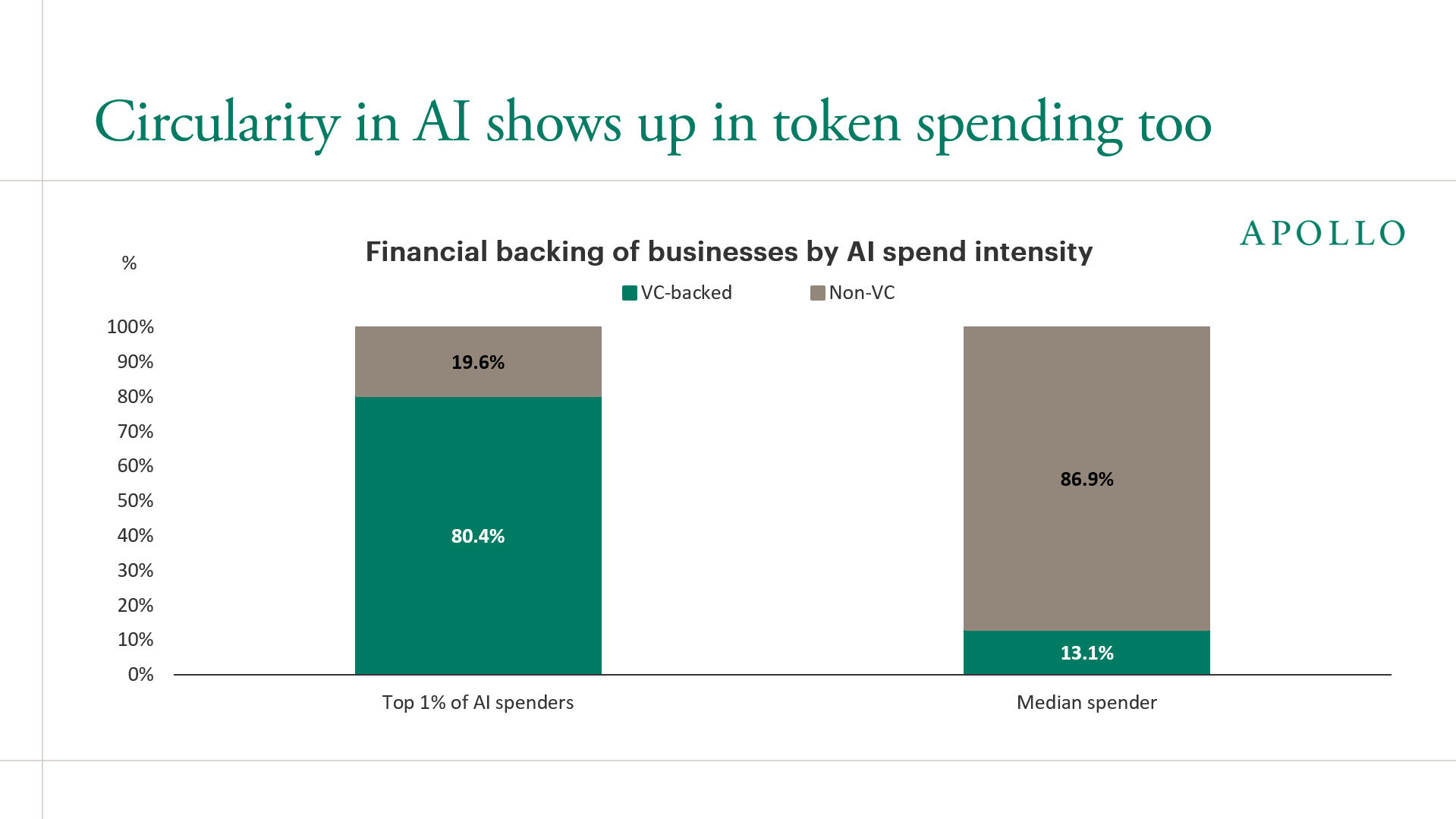
3. As a former management consultant, this might be the worst use of a stacked bar chart I've ever seen: https://www.apollo.com/content/dam/apolloaem/images/daily-sp...
4. I don't know how you actually isolate AI productivity gains on a macro level. It seems pretty much impossible.
This whole thing is laughable.
wewewedxfgdf
keel-control
harry8
Not so much in accounting, which is a much easier problem.
Software devs eagerly trained their replacement.
JoeAltmaier
datas
davedx
sehw
realusername
thomasjeff1
Luker88
"Tech sector" is supposed to be much bigger than just 7 companies, no matter how big those 7 are.
This looks to me more like just a huge centralization of wealth.
[deleted]
rglover
It should be of zero surprise that the rush into AI has yielded limited results (if we're honest, both in and outside of tech)—you won't get a bunch of artists or creative thinkers out of a pliant, ironically agentic labor force. That's why most people say "it doesn't work": it's because they lack the skills and knowledge to use it properly (but corporations want to delude themselves into thinking they have a genie in a lamp).
w10-1
AI in medicine has become pervasive, resulting in less time spent fighting IT or staying up-to-date and more time with patients; no one need be fired because you can always do better work.
It's the opposite of enshittification: quality has gotten better without any visible economic difference.
aelsi
jmyeet
We are functionally in a recession. The only way this isn't true is because of AI investment [1]. Additionally, GDP itself is flawed because it is propped up by housing, specifically imputed rent [2]. Another ticking time bomb is the $4T private equity backlog [3].
The real product of AI of labor displacement and wage suppression.
So while this article sees profits flat outside of the Mag 7, it should really be in decline to being flat is actually an improvement (IMHO).
We're not producing anything anymore. All we're doing is driving up revenues on inelastic demand on things like food, housing, electricity and health care. That's all PE is. And that's all our economy does now.
I really think people are underestimating just how close to breaking point our society is.
[1]: https://uhero.hawaii.edu/would-we-be-in-a-recession-without-...
[2]: https://www.taxresearch.org.uk/Blog/2023/02/14/10-or-gdp-is-...
pokstad
AI does not understand accountability, trust, culture, unwritten rules, ethical trade-offs or fairness, all of which shape reputational risk and ultimately drive revenue growth and profit margins.
This reminds me of the book The Redemption of Time. An alien society incapable of lying has no other way to understand deception than to study an actual human mind. The different ways that we are capable of thinking can be so hard to capture in an artificial system.
WheelsAtLarge
AI productivity gains are coming make no mistake about it. My guess is that we'll see them within the next 5 years.
toomuchtodo
Only 13% of companies see real returns from AI, survey finds - https://smackernews.com/item/50207881 HN - October 2026
johanneskanybal
I would expect new disruptors to eat the lunch of the old, but that's slow.
addozhang
lurquer
(1998 version of the story)
motohagiography
All that’s left is offence surveillance logistics and insurance for a breakaway civilization.
roosterIllusi0n
They don't have the people. That is why all the big players keep using financing nonsense to buy everyone up. Killing competition is all the monopolists have left.
trvz
This may well remain a "true communism/socialism has never been tried" situation.
AbstractH24
The other is that there is so much more value to be extracted before this bubble burst.
Not sure which I believe, objectively. Subjectively, inside of tech, it certainly feels like the former.
wonderwonder
mlindner
deadbabe
OrvalWintermute
Suggest Apollo is not doing a good job of measuring improvements since these are soft costs and harder to measure. But, instead of saying that, they are just repeating a low IQ take.
Zambyte
AI labs are focusing on automating and accelerating AI research, because that will accelerate AI development in other fields. Claims that non-tech topics are harder to train for are wildly over stated in this thread. Labs are focused on beating each other to RSI, and training on tasks that do not support that are a lost opportunity cost.
bigstrat2003
0xbadcafebee
What's embarrassing is how many people are clueless about where AI is going. The tech sector is one giant echo chamber, so it thinks whatever it makes will be a miracle cure. Everyone outside the echo chamber has no idea what it is/how it works, so they're just hoping it's the miracle cure the echo chamber keeps saying it is.
In reality, AI is just a minor improvement in productivity that doesn't solve hard problems. It does what we could already do before, a little faster & cheaper, without determinism/trust. It's a bigger, faster truck, but somebody still has to drive it, find a place to park it, spend more on gas, etc. It may be able to "think", but it won't replace humans until it can accept liability.
einpoklum
the technology has delivered zero financial payoff to corporate America outside of tech.
I wonder if the argument cannot be made that it has delivered little payoff in tech as well - in terms of actual stable revenue vis-a-vis the immense capital investments, the deep loans, the circular commitments etc.
j45
blurbleblurble
baby
lukasm
ckx
yieldcrv
1. every business unit and department was neglecting a best practice due to lack of investment in their organization. it has always been that way for decades and always will be that way because it isn't economically viable for it to be any other way. the workflow automations and agents we create act as digital workers that either do that neglected part, or let the rest of the organization do that neglected part.
2. the whole company always starts the year off with a bunch of goals, and by Q3 most of them are cancelled. now less of them are cancelled.
both factors mean that anyone just looking at "worker productivity" or "did we save money" is going to get the answer of no. everything is costing you the same, or the AI itself is costing you more. whatever contract I'm working under is definitely going to cost you more, if you don't cancel all those enterprise SaaS seats we told you to cancel.
I see a path to savings, but I don't think that's necessarily the metric to focus on. you need to look at the whole corporate structure, why are you still doing certain things, because those pressures will just make the org do more things because nobody is empowered to say "wait, maybe this is dumb"
ethical
m0llusk
archagon
The industrial revolution produced physical goods at scale, which eventually gave regular people access to things they could not have before.
AI produces intellectual labor at scale. Regular people do not need mass-produced content in their lives: there's already too much music, too much TV, too much software that only seems to get worse year after year.
Who needs mass-produced intellectual labor? The owning class. This is the only population segment that stands to benefit from this revolution. It's the reason every tech CEO is trying to shove AI down everyone's throats. It's the reason they're resting their feet on the table while everyone below them is starting to panic about the future of their careers.
I don't believe we will see compounding acceleration of anything other than spam and enshittification in this AI-laden world. This is not technology for building futures we can barely dream of: it's a gold-plated gift to the oligarchy and a fuck-you to everyone else.
zzzeek
IshKebab
It'll probably be a couple of years before most companies even realise it's an option.
bob1029
There have been wins with the customer facing side of the business, but the development team seems to be the biggest problem right now despite the direct & obvious applicability of these tools. I know they aren't a special unicorn edge case because I was very rapidly solving their issues before they stopped handing me things that revealed the lethargy.
Within the sector where these tools definitely work, the biggest barrier to effective adoption is figuring out a way to undermine the various ideological high grounds. I have found the most effective argument to untangle this knot to be something approximating:
Challenge:
"Why should I adopt or help to implement technology that might eventually replace my job?"
Response:
"Because refusing to won't protect your job. It puts everyone's job at risk."
It doesn't matter if you protect your job (not using AI) if the entire company goes to the bottom of the ocean as a consequence. The neat thing about this is that your job is part of the set known as "The Company" and if that ceases to exist, so does your job. Good luck suing a dissolved entity for unemployment or whatever. There is enough competition in most markets to punish anyone who thinks they can win on virtue alone.
haunter
briHass
The incredible improvements have only been over the last 9 months or so. Business, especially disrupting entire job functions, takes much longer than that. As is typical with this type of change, it'll be slow until a tipping point, then FOMO will hit.
You can see a similar history with electrification. A few industries went quickly, but then it took like a decade of little growth before the true benefits showed up. As an example, take a factory that was built around hyrdo-power like a grain mill. You can't just take an electric motor and drop it in in place of the water wheel. It doesn't fit, the wheel is outside, there isn't room between the mill and the wall, etc. Only when you completely rebuild a new mill building designed around the features and limitations of the electric motor do you see the major benefits.
Same thing here; it will be new factories and new companies that are designed from the ground up around AI and its benefits and limitations that really move the needle.