example.com/path/to/article
000 points · username · 0 hours ago
example.com740 points · 184 comments · 7 years ago · _lo3k
I realized today that I’ve always considered them in the moment and let them go. Perhaps I should have been bookmarking them and revisiting with a different perspective.
AWebOfBrown
RickS
Sometimes someone will stop at my fire and warm themselves without my ever having paid attention, but to them it may have meant all the difference in the world. By keeping this obligation in mind, to simply expect people to need a place to sit a spell, I can at least believe I am helping.
The campfire is a nice way for me to remember we're all suffering, that not a one of us is unique to loneliness. Because sometimes that person who sits down at your fire is the person you have been waiting for, and only by making a seat for them were you able to ever meet.
memco
The Reverend Doctor Martin Luther King Junior (in whose honor I had a day off of work today) never once called for 'tolerance', the boycotts and sit-ins were not a demand for tolerance - they were a demand for integration. To tolerate is to "otherise" - you are _allowed_ to continue being as your are, but on the outside. To integrate, you do not require permission, but you do not continue as you are - both "sides" are transformed by the process.
weinzierl
https://news.ycombinator.com/favorites?id=weinzierl&comments...
I didn't put a lot of thought in it, I just favourite stuff I might want to reconsider later. One example I still like is:
You can hide from your your boss, your wife, or even your mother, but you can’t hide from Facebook.
Browsing others pages can be quite insightful for what they find notable. Not everyone uses this feature, so not everyone has favourites and it takes a little digging to find good ones. For example here are Thomas Ptaceks:
https://news.ycombinator.com/favorites?id=tptacek&comments=t
Austin_Conlon
https://smackernews.com/item/11050299 HN
Mocks Populi
There is a an apocryphal story in which your anonymous correspondent was on a small business jet somewhere between Davos and Dubai, when he asked a former Thatcher minister what shade of pink the Financial Times newspaper was. "Parlour," the minister replied. It is in the spirit of this self-referential anecdote that an auspicious news peg has provided an opportunity to sound off on a pet saw and perhaps let on that I went to Cambridge.
Broadly, this newspaper is neither here nor there on a given issue, other than to say that it is different from what you expect - and for reasons that may surprise you. The prediction will be driven by the available data, include a smirk at the newcomer, and give a sop to the status quo. All things equal, it will predict outcomes that are some function of the sum of elements by the number of elements, and provide a view that is "radically centerist," if perhaps a bit smug. A reversion to the mean, indeed.
-- Every Economist Article Ever
debaserab2
"OOP is just a mental model. Deep down everything is made of bits. The church of OOP has failed but if something looks like a duck, walks like a duck and talks like a duck it probably is useful to make a duck class. We're now down to fighting for nuances. You can do most things with OOP or without OOP but each path has some upsides and downsides and most of the time it's good to use some things it provides where it makes sense and not get too religious about it. The great architect has the foresight on how the code will be used in five years and design it accordingly." https://smackernews.com/item/18250466 HN
factsaresacred
This is the biggest mistake most of the people make. If it worked that way, every weekend app released here would be making tons of money...But this is NOT app v/s app game. This is business v/s app. And you can't take down a business with an app. You need to create a business. Sure you can build a better 'app' than Evernote or make a better burger than McD's but you can't make a better business, the day you do - you are in game.
On building one-person startups (both from jasonkester):
Your $10k MRR niche won't be "app that lets people hail taxis, and network of contract drivers." It'll be "reception table plan designer for wedding coordinators". Google is not now, nor will they ever be, having a meeting where they decide to allocate a few hundred engineers and marketers to crush that space.
There are tens of thousands of niches like this that will pay for teams of 1-3 people to live on the beach after a few years of work.
and
Personally, I prefer to listen to the person who has tried a thing and declared it possible, rather than the person who has never tried that thing and declared it impossible.
On the risk of choosing Firebase (and similar PAAS providers):
Way to risky not to use for startups, IMO. What would you prefer, spending half your time doing backend development to get a system that might be 80% as reliable as Firebase on the off chance that your startup will survive long enough for your custom engineered solution to bare fruit, or spending all your time actually building your product and launching quickly so you can determine whether or not your startup is even viable?
wallflower
https://smackernews.com/item/8649415 HN
"Teach them to be better than you. That may seem counterproductive. I have a type A personality, and I have decent coding skills. I've been in your situation a number of times. I also know there's these mythical expert developers out there that I can't seem to find (or afford). So, what to do? A few years ago I realized that if I continue down this path, I'll end up with some serious health issues due to the stresses that come along with having a reputation for being a really good developer. So, I decided that instead of searching for developers better than me, I would teach developers I work with how to BE better. It's taken a lot of patience. And it's taken me quite a bit to LET GO of my way of doing things. I had to take my ego out of the picture. (VERY hard to do.) Nowadays, I realize that developers don't have to BE better than me. I simply have to ALLOW them to do what they do without being so obsessive about it. Turns out, even junior developers really CAN do good work. They just need a little guidance that only comes with experience, and then they need me to get out of their way."
jakelazaroff
sevensor
https://smackernews.com/item/17020655 HN : A question I had asked about interfacing Excel, which provoked some useful responses. I now use this as my authoritative list of ways to extend Excel's functionality.
https://smackernews.com/item/18314265 HN : Fascinating comment about, well, all kinds of stuff, but mainly PostScript. (DonHopkins. Another user whose comment history is a seam of gold.)
https://smackernews.com/item/16014573 HN : Great post about the history of terminals and terminal emulators. (JdeBP)
https://smackernews.com/item/15027372 HN : Introduction to the market for produce by the produce buyer for a small grocery. (LightRailTycoon)
YjSe2GMQ
And here's the live (well, lagging a few months, but this is a very slow signal anyhow) version: https://smackernews.com/item/14950203 HN
acheron
> Can we please try to stop talking about this specific language ecosystem as an awful deplorable hell hole or whatever?
Back in the second century BC, Cato the Elder ended his speeches with the phrase 'Carthago delenda est,' which is to say, 'Carthage must be destroyed.' It didn't matter what the ostensible topic of the speech was: above all, Carthage must be destroyed.
My opinion towards JavaScript is much like Cato's towards Carthage: it must be rooted out, eliminated and destroyed entirely. I don't know if I'd go quite so far as to say that the fundamental challenge of mass computing is the final destruction of JavaScript — but I want to say it, even though it's false.
JavaScript is a pox, a disaster, a shame. It is the most embarrassingly bad thing to become popular in computing since Windows 3.1. Its one virtue (that it's on every client device) is outshone by its plethora of flaws in much the same way that a matchstick is outshone by the sun, the stars and the primordial energy of the Big Bang added together.
JavaScript is the XML, the Yugo, the Therac-25 of programming languages. The sheer amount of human effort which has been expended working around its fundamental flaws instead of advancing the development of mankind is astounding. The fact that people would take this paragon of wasted opportunity and use it on the server side, where there are so many better alternatives (to a first approximation, every other programming language ever used), is utterly appalling.
JavaScript delenda est.
om3n
"Like almost all problems in life you have only 4 options: #1 Change you (accept what you are unable to change)
#2 Change the other (convince them to follow your vision)
#3 Fly (divorce, quit)
#4 Stay and suffer (include drinking, doing drugs, whining)
It is amazing how many people chose number 4."
zachwill
    Very frequently, the right answer for a MVP is something
    like an e-mail newsletter, or a Salesforce extension,
    or a CSV file, or an IDE plug-in, or throwing a pizza
    party for your target market and performing the service
    for them yourself.

    I’ve seen startups charge $10K+/month to dump a CSV file
    on a client’s FTP server. Go where the user can most
    conveniently make use of your product; for a lot of
    businesses, that is neither app nor website.
pmlnr
We saw the same with the printing press: the Powers That Be first banned it, then tried to control it, and eventually had to relent. It will happen with data sharing too, eventually. It might take a century, but it will happen."
dekervin
"This is basically a repeat of SEO. At first, you have the early adopters. Things grow organically and it doesn't feel like a zero-sum game because there aren't many players.
Next comes the growth phase, where more people get involved, and start competing for attention/clicks/votes/whatever points system.
Next comes the exploiters, who discover weaknesses in the system and take advantage of them. They tend to make a lot of money because there's not much competition in this niche.
Next comes the crossover, where the exploit knowledge becomes public, and everyone now must do it because everyone else is.
Next comes the shutout, where the company running things starts actively punishing bad actors, but by this time, being a bad actor is essential to survival, so people do it anyway. It becomes a game of cat-and-mouse, new exploits, new mitigations.
Eventually, the company manages to fix their algorithms enough that the exploits don't offer decent marginal returns anymore, and it returns to what the company originally intended: 1% of people are successful, 99% of people make next to nothing, and the company makes shitloads.
And then the new big thing comes out. The old system goes into decline and the new system starts to take over. Rinse and repeat. "
I map comments I like into coherent arguments using this [0] (An example here [1] ). I would love to share maps with others even if it is not ready for public use ( you only live once ! )
[0] http://clean-ico.appspot.com/
[1] http://clean-ico.appspot.com/static/site/Symbol/index_argume...
rainhacker
What if you went to your manager, or whoever you feel is the right person, asked if you could speak one on one, and said... "I really love working at this company. The work is interesting, I love the people, the culture, <one more legitimate pro goes here>. But I also know I could be making X if I went elsewhere. I love the work I'm doing, and I want to keep doing it here, but I also don't want to be leaving money on the table. What can we do?"
This phrasing, pretty much verbatim, has worked really well for me in the past.
On multithreading in Redis [1]:
The problem with clustering still becomes lower queries per GB as instances can’t share data. Redis itself runs in RAM so storage is at a premium. One of my main reasons for doing multithreading, and FLASH in the first place was to make Redis work well for much larger value sizes.
I really think we have different use cases in mind.
A book recommendation [2]:
"Basic Economics" by Thomas Sowell. Not an easy read, but it deeply changed the way I think about incentive structures and the law of unintended consequences. It's a tough pill to swallow for people (like myself) who cling to utopian ideas, but the older I get the more I realize we must live in the world as it exists, with human nature as it really is. Dreaming of a better world is counter-productive if one does not engage with reality. We can build a better world, but only by being honest about the current state of things.
Links to parent comments: [0] https://smackernews.com/item/19539485 HN [1] https://smackernews.com/item/19370712 HN [2] https://smackernews.com/item/19087418 HN
dmitryminkovsky
> But he was tenacious; he would never give up on anything.
To be fair, in my mind this is the one most common trait I find in successful entrepreneurs and leaders. I've seen leaders who I didn't think were particularly bright, or extroverted, or empathic, but man, did they not get stressed out by obstacles that came in their way. They either sidestepped them or overcame them, but they did not dwell on them and let those obstacles lead to self doubt.
Also really appreciated this articulation https://smackernews.com/item/19350161 HN
Leadership is basically just people-engineering and business-engineering. Engineers use tools to build products, and so do leaders.
The immediate assumption is that people are tools/resources to build the product. That's talking like an engineer.
Don't use your team to work on a project/product. Use the project to work on your team. They're not there to build the product. They're there to gain some personal fulfillment. Use the development of the product to grow them.
e12e
https://smackernews.com/item/19405173 HN
" js2 37 days ago | parent | un-favorite | on: Beto O'Rourke's membership in America's oldest hac...
Fox News: "Young Beto O'Rourke wrote 'murder fantasy' about running over children, was part of famed hacking group: report"
CNET: "Beto O'Rourke has serious hacker credentials. The presidential candidate was a member of hacker group Cult of the Dead Cow"
WaPo: "'Psychedelic Warlord': Beto O'Rourke's past life as a teenage hacker" and "Beto O’Rourke’s hacking universe, explained."
Sources: (... See original comment...)"
hadrien01
You enter a coffee shop. Before you can do anything, the owner takes a photo of you, and grabs your hand to take your finger print. He quickly writes down the date, time and what clothes you are wearing.
He gives you a smile as he starts his speech. "Before we continue, we at Coffee City want you to know we deeply value your privacy. We need your permission to store your information, improve your coffee experience, personalize your coffee suggestions and share it with our partners. Do you consent?"
You don't fucking value my privacy. I get some serious doublespeak vibes. If you valued my privacy you'd leave me the fuck alone and stop saving information about me.
sid24rane
----------------------------------------------
1. Find a popular SaaS product. Like Intercom, Algolia, Segment. Make sure it doesn't have a free plan. This guarantees there's a market for the tool. Check out GetLatka for ideas. https://getlatka.com
2. Build your own take on the product. Find the minimum set of features that make it valuable. 10% of the work for 80% of the value.
3. Sell it at a 50-90% discount. There will be price sensitive customers that want the popular product, but don't want to or can't afford it.
4. Target bottom of funnel marketing channels: Targeted quora questions. Paid/organic search queries. Set up retargeting ads on Facebook. Product hunt launch it. That should get you a steady stream of customers.
I don't think this is a great way to build a million dollar business, but is a very easy way to make a few hundred. Shoot me an email if I can be helpful.
-----------------------------------------------------
Don't exactly copy another product. It's damn important to reinvent defensible products that either, and hopefully do all of:
a) solve a slightly different problem
b) target different users
c) solve the problem in a 10x better, compelling way
-------------------------------------------------
TIME. Time is the MOST precious commodity. Help users SAVE TIME. Save time finding something of value to the USER. You can't "presume" how much to charge. You have to "TEST" pricing then keep jacking it up until your customers don't pay. How can you pay for something what does not offer value. Stay small. Stay NICHE. Grab a slice from a BIG market. Forget millions. slap-yo-self with fury with delusions of becoming a millionaire, and make a goal of making enough to avoid being trapped in a 9-5 lifer situation. It take a LOT of luck + skill + market segment expertise. Like you have to KNOW the market you are going to be competing in. Assisted living , senior care , retirement calculator is VERY hot now. You'll be at it after your day gig 6pm-2am testing / building / iterating. Good LUCKY. launch a free beta version learn what customers value and how much they will pay ( ask them) THEN when you have enough people crack addict addicted to your service / app start charging. Be merciless. But offer excellent customer service. Always be honest.
------------------------------------------------
While I agree with some of the tactics here (make a twist on similar ideas, contact businesses, buy a business, brush up an existing product you built)
I'm going to suggest an alternative method that has worked for me.
Start with the money.
If you want monetization to be guaranteed you need to prioritize that first.
Take this method and rinse/repeat for you and your skills.
1) How much do you really want to make from this a month, what would make you happy?
Let's say you decide $1k a month would make it worth it after time, expenses and payment processing fees.
2) You then decide how many customers you really want to have to find and how much support email you want to answer.
Usually developers pick prices like $6 and wonder why no-one buys. This low price screams a lack of confidence in the product. That you aren't taking it seriously. That you may not be around in 8 weeks.
Starting without monetization in mind or equally, pricing low is the death of a product because for someone who dislikes marketing you just set yourself a huge marketing mountain to climb.
At $6 each, finding and selling to 150+ customers - when you don't even have one yet is a huge trek to your $1k happy place.
Let's say you feel more confident about finding and serving 10 customers really well. That seems achievable, right?
So with just 10 customers we're looking at a $100 a month product, right?
Whoa, you're thinking you could never build something that's worth that much.
Maybe you're worried it's enterprise level costs now and that's not the type of product you want to build.
Don't worry, a $100 product can be really simple.
Often developers think that a big cost means solving a big problem and that a big problem needs a big solution. Not true at all.
A big problem can be solved with a small elegant solution.
3) Now we know how much we want to make and how many customers we need and how much we are going to sell it for.
We now need to find the problem we are going to solve.
So how big of a problem needs a $100 per month solution?
Not very big at all really.
Let's say a business owners time is super-conservatively worth $50-$100 an hour.
So to add value, we are looking at saving someone between 2-4 hours a month on a task they normally have to do manually. That's not too bad!
Or maybe you want to help them reduce their business costs by $200-$400. Also, very possible. Now we have the value proposition.
We know what kind of problem we are looking for, so value will be clear for the customer.
4) Now we decide _who_ this is going to be for.
Don't pick people the same as you. They have the same skills and can solve the same kinds of problems that you can.
Pick a group of people :-
- That are easily identifiable by what they call themselves on social media (blogger, podcaster, videographer, designer, public speaker etc)
- Make sure they are a group you like interacting with, that you have some experience of working with already in some way (please pick a group you like and care about)
- Make sure they are the decision maker in their own business (don't pick employees of big corps)
- What tech skills have you worked with that overlaps with this customer group?
Let's say you've worked on a few video platforms in the past so you know that space well, so you choose to help YouTubers.
5) What is the issue that we are solving?
Ok, so now we're helping YouTubers to either save 2-4+ hours a month or reduce costs by $200+ - for your $100 MRR product.
This is where we breakdown what it takes to run their business.
What stops them being more profitable?
What tasks do they do everyday?
What can be automated?
What do they hate doing in their business?
If you know this space even a little, you will have answers here.
Maybe video storage is a huge expense.
Perhaps running their community takes up too much time so they can't scale.
Is just publishing a video end to end super time consuming? Look at why.
If you don't know what matters to them, ask. Make a hypothesis and see if it's true.
In just a couple of DM's you might find that they spend a whole day a week on something repetitive. Or are spending money on something that you can optimize. Write a few possibilities down.
6) Make an offer
In just a day or two you can go from no idea, to identifying a significant pain point for a group of people that's easy to reach.
Now you consider a couple of small technical solutions for the problems you've found.
You go back to a couple of your ideal customers and make them a proposition.
Something like - "You said you spent X hours on this particular problem. If I built something to solve that, this week, would that be worth $100 to you?"
If it's a huge pain point they will bite your hand off. If you get weak responses - no worry, you've not built any code yet. You can use the conversation to get to a deal.
They might say it's worth less so you find out what features would be needed to make it worth the $100.
Maybe they suggest a different problem that is more urgent for them.
After a few conversations you should have at least a couple of paying customers and a clear solution.
8) Building
Now you know exactly what you need to build and have customers waiting. There is no excuse but to launch. This will help you focus on the truly essential code.
As you build, reach out to a few more potential customers. (we made sure they were easy to find earlier) Ask them if they have the same problem. Show them what you have.
Go through a few cycles of building and feedback. Make sure people are paying you what you set out in the beginning - or close to it.
Ask your starting customers for referrals. You'll reach your 10 customers with zero marketing spend.
You then have all of the elements needed to scale further if you wish!
Remember that code comes last in this method for a reason. Only build when you have paying customers.
weinzierl
sanj on July 18, 2007 [flagged] [-]
Did you win the Putnam?
If not, please don't be "bolder" than this guy: http://en.wikipedia.org/wiki/Ravi_Vakil
cperciva on July 18, 2007 [-]
"Did you win the Putnam?"
Yes, I did.
jakobegger
krrishd
“Augmenting human intelligence, while leaving the hearts as they are, is a loss, not a gain.” - https://smackernews.com/item/17196155 HN
Invictus0
marco_craveiro
"Emacs is basically a text centric computing platform, built with a flavor of Lisp."
th0ma5
maximente
janvdberg
dandelion_lover
https://smackernews.com/item/12751461 HN
2. "Do not use the Internet. Do not use phones. Do not use bank accounts. Do not travel by plane. Do not enter public spaces. Do not show your face.
Otherwise you accept our Terms of Service.
Thank you for trusting us."
a_c
Brajeshwar
Once there was a longish story about how to fix a furniture company (in context to Evernote). I have shared that with quite a lot of people, including quite a few CXOs.
csours
Commentary on limitations of SQL - SQL is not composable.
This comment made me think of composability in other other contexts as well, such as requirements specification.
filomeno
https://news.ycombinator.com/user?id=luckydude
Unfortunately, he hasn't written any comment here for more than a year.
wallflower
APOLOGIES for making this post so annoyingly long, but I really hope you find value in the words below. -----------------------------------------------------------------------
I'm going to first share a personal experience from my early trading days to illustrate where I'm coming from. I used to wake up at 4:30 am everyday in the Chicago suburbs to beat rush hour traffic and make it into downtown Chicago at 6:30 am. In order to wake up so early, I fell into a habit of sleeping at 9:00 pm and like a robot waking up at 4:30 am. This simple routine was indirectly helpful when things seemed darkest.
For the first six months, I lost money and was ridiculed constantly by other traders who were more successful than me (which was about 20 other guys CONSTANTLY using me as a punching/whipping bag). The only thing that kept me going was the fact that some of the very same traders that would be making wise cracks at me for losing money were some of the most successful people I knew at the time. For better or worse, if I needed a trader to model myself after, it was the same people that were telling me how bad a trader I was - and although I was not open to really hear what they were saying, they were right about my skills in every way (but their feedback was always packaged in some sort of insult).
After racking up some rather hefty losses, I was determined to quit at one point during month four, but because I had a habit of waking up at 4:30 am I simply "forgot" that the night before I told myself I would quit and spare myself further humiliation...by then I was warned that I was now on the red list of traders ready to be cut. Also, my personal savings were starting to approach zero (the base "draw" for house traders was enough to pay for food; you usually make your money on a percentage of your profits, and I was deep in the red at the time).
To say the least, there were many excellent reasons to be "reasonable", forget about my dreams, and quit.
After 4 consecutive "failures to quit", I realized that I didn't quit because somewhere deep down I was hanging on to a dream, however remote at that point: that I could somehow be as successful as the other traders that I knew. At the same time I realized that I had hit rock bottom in that I couldn't even succeed in failing! Very tough times indeed...
An interesting point to note here is that although my losses were starting to get very large, the people who were funding me as a trader kept me because I had one redeeming quality: EFFORT, and this helped build tenacity. Other traders who barely traded but had a fraction of my losses were cut much faster because they didn't put forth much effort. They were not willing to take losses and be bold/brave and fight it out; I was willing to take risks, and this saved me from getting cut faster than others.
Slowly I began to reinterpret the constant humiliation I was suffering: perhaps the other traders were right about their "jokes" and there might be something in what they are saying that will help me get out of the red. I also realized that since I had failed at quitting (which was now the ULTIMATE failure), there was no further failure for me and that if I took baby steps they were surely to succeed (this translated into taking smaller trades/profits).
Only after improving upon my abilities as a trader and channeling my energies appropriately did I succeed and earn everybody's respect as a trader (and you have no idea how this made me feel!). I quickly made enough in commissions to be trading my own account, and be successful as an independent trader onward. When I look back at those final months of 1999 (yeah that's right, I was losing huge cash at the end of 1999 when the entire market was going crazy UP!), there was more good than bad even when I was getting my ass handed to me. It's just that I was intentionally creating my own feedback (I'm right everybody else is wrong) instead of seeing the results I was getting (losses/insults) as feedback and information that would help me be successful.
I kind of snicker every time I see somebody ask for feedback on their startup on YC.News only to end up justifying themselves by telling everybody why they did what they did when they get negative feedback, which is the feedback of greatest value. If somebody tells you how crappy your idea is, thank them that they even spent a few brain cycles considering your idea.
The lessons I learned from this that are perhaps relevant to your questions:
- Determine if you believe in yourself to succeed as an individual (I know this sounds odd, but for a moment just examine your thought patterns and your actions and see what message you are sending to yourself; do you listen to the voice that says you can't or are you paying attention to the feedback from your efforts and the results you are getting?)
- Search deep down inside and see if the project you are working on is something you believe in or not. If you can't sell yourself, then you shouldn't bother trying any further...
- ANY attention you get for your efforts is good attention. If you get LOTS of negative feedback, then be grateful - you've jumped the first hurdle of getting people to give a damn about what you are doing! :)
- There is responsibility and accountability that goes with both success and failure. You need to be ready for both because they can be equally painful in equal ways. The amount of accountability that comes with success can be more unbearable than the accountability that accompanies failure. I personally know of some very talented people who enjoyed phenomenal initial success only to find just as fast that they were in over their heads.
- The more you resist the possibility of failure then you are less likely to recognize possibilities that will help you succeed. If you are afraid to fail, then most certainly you are afraid to succeed. This sounds counterintuitive but it's based upon the fact that fear makes your mind less supple and less responsive to the changes that will push you out of the game - or conversely it will lessen the impulse to jump on the opportunities you need to succeed.
- The results you get has everything to do with your users/market and less to do with you as an individual; it's sometimes hard to separate these two. See the other side of the equation and what side you are on before trying to solve it. Don't ever think you are above the feedback of your users...EVER!
- Don't have expectations (this is just setting yourself up for failure). Because you are starting out you may not know what is best to help you succeed - ESPECIALLY if you're lacking motivation. Keep in mind that whatever results you get from your efforts will lead to more possibilities (in the form of additional information).
- Have some behavioral "context" within which to exercise discipline and structure. Seek to grow your efforts within this context. My context was my sleep schedule. It was a routine that was so ingrained that my drive had a laser focus. This might not work for some, but it worked for me.
Finally, I will add that in my opinion failing hard and fast is MUCH better than failing slowly. The faster you know for certain something isn't going to work out, the sooner you can cut your losses and move on to your next idea. When you eventually succeed, you will look back at all the times you were quick to cut your losses and get to where you are...
---------------------------------------------------------
Please do NOT contact me asking for advice in trading/investing. This is a VERY personal thing, and it has everything to do with who you are, NOT with how much information you have, or which tools you use, or who you know.
xenophonf
saagarjha
JustSomeNobody
relaunched
pvaldes
https://e360.yale.edu/features/extreme-botany-the-precarious...
snazz
valueprop
skun
dontbenebby
varjag
EventH-
krm01
noahster11
I always enjoy the satirical content about last weeks hackernews posts
therealmarv
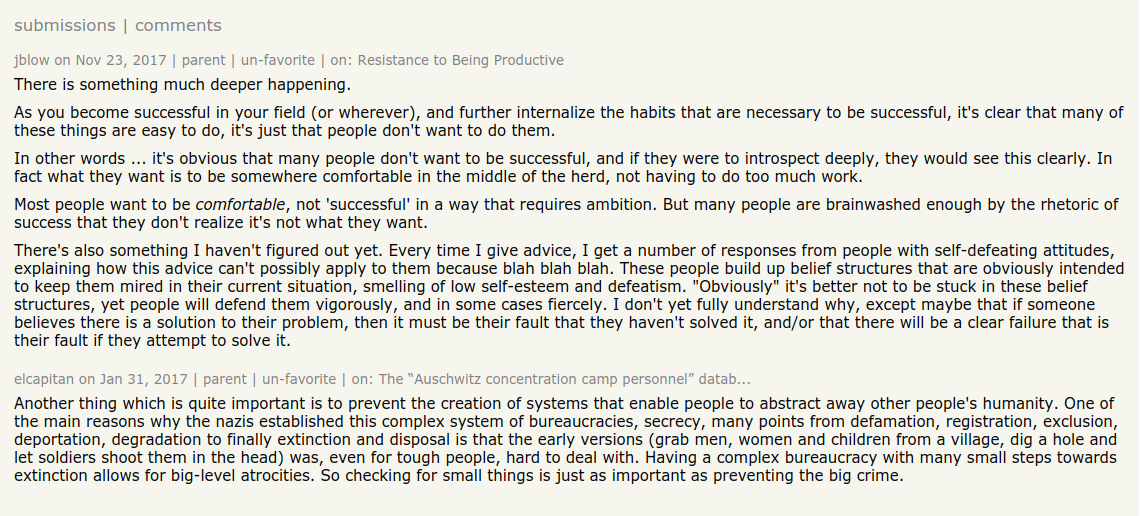
"Salaries never stay secrets forever. Hiding them only delays the inevitable. Last year we were having a discussion at lunch. Coworker was building a new house, and when it came to the numbers it was let loose that it was going to cost about $700K. This didn't seem like much, except to a young guy that joined the previous year and had done nothing but kick ass and take names..." (edited for brevity).
"...The conversation ended up in numbers. Coworker building the house pulled about $140K base (median for a programmer was probably $125K), and his bonus nearly matched the new guy's salary, which was an insulting $60K -- and got cut out of the bonus and raise in January for not being there a full year, only 11 months.
Turns out he was a doormat in negotiating, though his salary history was cringeworthy. It pained everyone to hear it, considering how nice of a guy he was. In all honestly, $60K was a big step up for him. Worst of all, this wasn't a cheap market (Boston). The guy probably shortchanged himself well over a half-million dollars in the past decade. This was someone who voluntarily put in long hours and went out of his way to teach others, and did everything he could to help other departments like operations and other teams. On top, he was beyond frugal. Supposedly he saved something around 40% of his take home pay, despite living alone in Boston. He grew up in a trailer park.
He spent the next day in non-stop meetings with HR, his manager and the CTO. That Friday he simply handed in his badge without a word, walked out and never came back.
Until 3 months later. As a consultant. At $175/hour."
https://smackernews.com/item/2439478 HN